How AI Economics is reshaping value creation, workforce strategy, and the next era of skills intelligence.
The popular narrative says that AI is coming for our jobs. But the truth, especially across digital infrastructure, professional services, and education, is far more compelling: AI isn’t eliminating work—it’s reconstructing how value is created, priced, and delivered.
As thought leaders at TSIA, including George Humphrey, Thomas Lah, and Bo Di Muccio, Ph.D., have highlighted, this is not the end of services. It’s the redefinition of them.
AI as a Catalyst, Not a Replacement
Thomas Lah put it succinctly: “AI doesn’t eliminate services—it elevates them.”
Across the data center and cloud ecosystem, AI is automating low-value, repetitive tasks — freeing people to focus on strategy, integration, and continuous optimization.
In this shift, human expertise becomes the differentiator. The most valuable professionals will be those who can design, implement, and sustain intelligent systems that AI alone cannot contextualize.
At Innovorg, we see this evolution firsthand. As AI takes over repetitive functions, the need for strategic, certified, and adaptive teams grows dramatically.
The Market Demands Radical Transformation
As Bo Di Muccio, Ph.D., points out, the future of services is not about replacement but radical transformation.
For organizations operating in digital infrastructure, this means rethinking how Professional Services, Customer Success, and Support create and deliver value.
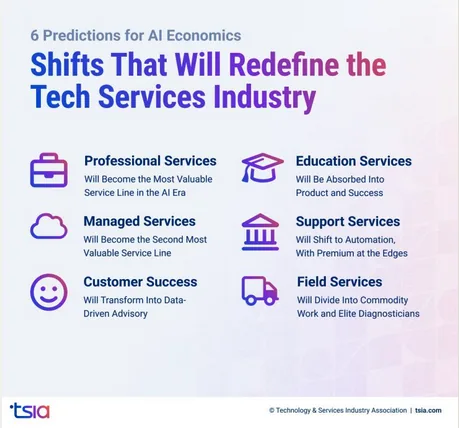
The most forward-thinking companies are already building what we call Workforce 2.0 — a workforce that is mapped, measured, and continuously developed.
This new model demands:
- Roles defined by outcomes rather than job titles.
- Skills and certifications measured and refreshed continuously.
- Learning that is adaptive, AI-driven, and context-aware.
The Economic Proof Is Clear
Even OpenAI, the company behind some of the world’s most powerful AI models, projects that “Professional Services and Agents” will grow into a $30 billion business line by 2029.
That projection underscores a fundamental truth: AI’s enterprise value is unlocked through human-led services.
Every technological revolution creates a skills acceleration curve, and we are now at the steepest point of that curve—where workforce development and AI must evolve together.
What This Means for Digital Infrastructure Leaders
For leaders across the digital infrastructure sector, this isn’t an abstract discussion. It’s operational reality.
You cannot automate resilience, compliance, or trust.
You cannot deploy or scale infrastructure without certified expertise.
You cannot optimize systems without adaptive learning and continuous development.
AI amplifies what people can achieve—it does not replace who you need.
The competitive advantage now lies in treating skills as an asset class—tracked, measured, and developed with the same precision as your infrastructure.
Forward-looking organizations are already aligning workforce data with business outcomes, using platforms like Innovorg to connect roles, skills, certifications, and learning performance directly to service profitability. This integrated approach provides real-time visibility into capability gaps and helps leaders make data-driven decisions on hiring, training, and investment.
New AI Economy
At Innovorg, we’re building the technology that enables organizations to adapt and thrive in this new era. Our platform empowers companies to:
- Catalog and connect every skill across roles and functions.
- Identify and close capability gaps that limit readiness.
- Deliver adaptive, AI-powered learning experiences.
- Link people, roles, and skills directly to business outcomes.
In an AI-driven economy, workforce intelligence has become the new infrastructure layer—powering performance, innovation, and profitability across the digital infrastructure sector.
The question is no longer whether AI will replace the workforce. The question is how quickly we can rebuild it to thrive with AI.
This is the time for digital infrastructure leaders to act — by upskilling, reskilling, and redefining the meaning of expertise in an AI-augmented world.