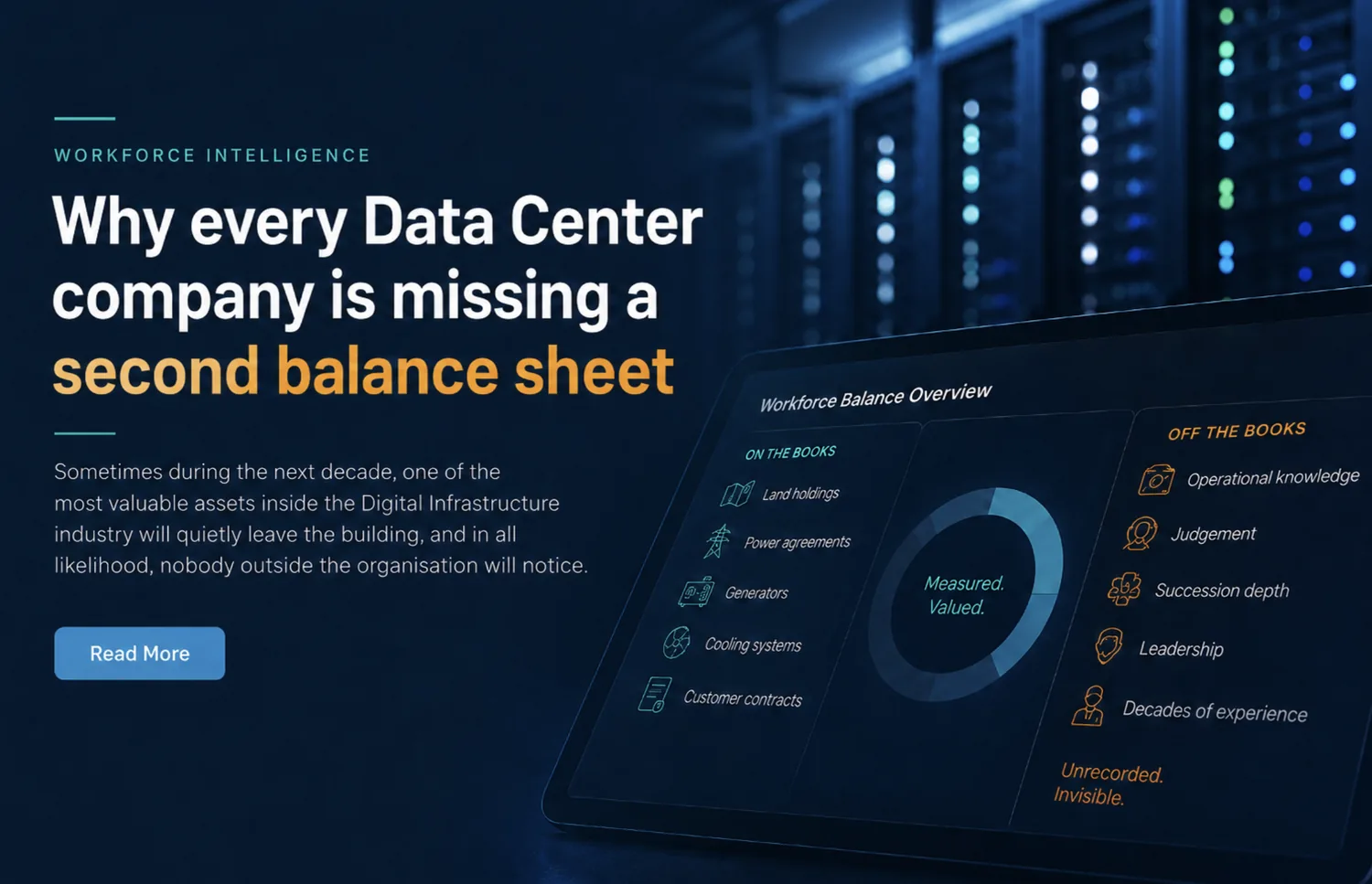
Sometime during the next decade, one of the most valuable assets inside the Digital Infrastructure industry will quietly leave the building, and in all likelihood, nobody outside the organisation will notice.
There will be no announcement to investors, no analyst note discussing the implications, and no adjustment to the company's valuation. The quarterly figures will remain unchanged, the development pipeline will continue to move forward, and the balance sheet will still reflect the same land holdings, power agreements, generators, cooling systems and customer contracts that existed the day before.
What will have changed for Data Center operators is something far harder to quantify.
A veteran commissioning engineer may have retired after thirty years of bringing mission-critical facilities online across multiple markets. A facilities director who has spent decades navigating operational challenges, mentoring younger colleagues and solving problems that never appeared in any manual may have decided it is time to step away. A project leader who helped shape multiple generations of infrastructure may have handed over responsibilities to a successor, taking with them a body of knowledge accumulated through thousands of decisions, failures, successes and lessons learned.
From an accounting perspective, nothing of material value will have left the business. From an operational perspective, however, the organisation may have lost one of its most important assets.
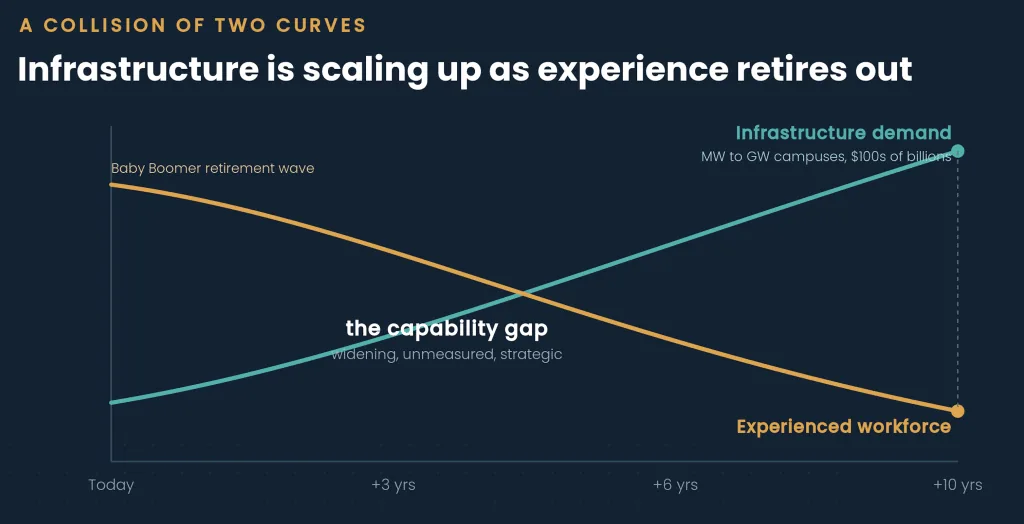
This is the uncomfortable reality facing not only the data center industry, but much of the developed world's critical infrastructure sector. Across energy, manufacturing, transportation, telecommunications and utilities, a generation of highly experienced professionals who built and operated the systems underpinning modern economies is approaching retirement. In the United States alone, millions of workers from the Baby Boomer generation are expected to leave the workforce over the coming decade, creating what many economists have described as one of the largest knowledge-transfer challenges in modern corporate history.
Digital infrastructure finds itself at the centre of this convergence.
Artificial intelligence has triggered the largest expansion cycle the sector has ever experienced. Global investment commitments measured in the hundreds of billions of dollars are being directed towards new data centers, cloud infrastructure, power systems and AI factories. Projects that only a few years ago would have been considered extraordinary are now becoming commonplace. Campus developments measured in hundreds of megawatts are emerging across North America, Europe, the Middle East and Asia, while industry participants are openly discussing gigawatt-scale infrastructure clusters as though they are the next logical stage of evolution.
Much of the debate surrounding this growth has focused on physical constraints. Power availability has become a boardroom issue. Land acquisition strategies are scrutinised by investors. Supply chains remain under pressure. Access to capital continues to shape competitive positioning.
Yet beneath these visible challenges lies another constraint that receives comparatively little attention despite its growing strategic importance.
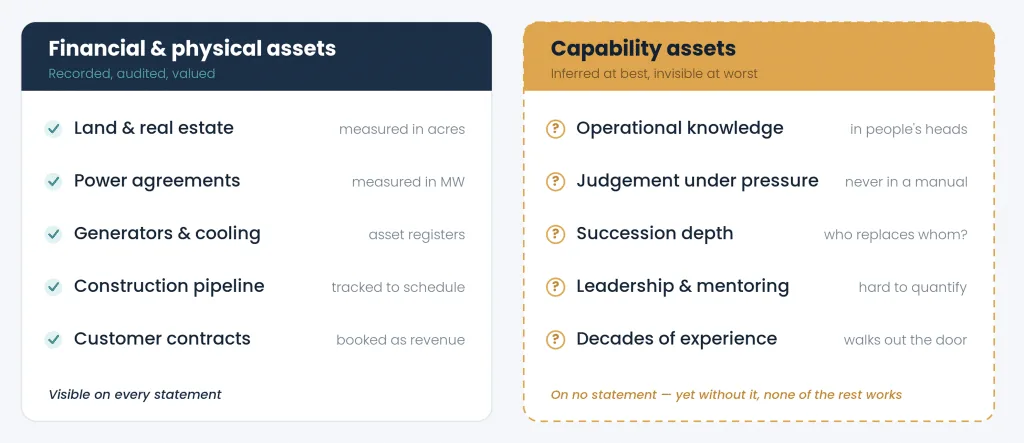
The data centre industry has become exceptionally sophisticated at measuring financial assets and physical assets, while remaining surprisingly limited in its ability to to understand and quantify workforce capability.
Companies know how much power they control. They know how much revenue has been contracted. They know the status of construction programmes, customer commitments and financing arrangements.
Far fewer organisations can confidently answer questions such as where critical operational knowledge resides, how dependent they have become on specific individuals, which teams face the greatest succession risks, or whether the workforce possesses the capabilities required to support the next phase of growth..
That distinction matters because infrastructure ultimately operates through people.
A hyperscale campus may represent billions of dollars in capital investment, but the successful delivery and operation of that facility still depends upon thousands of human decisions. Engineers determine how systems are commissioned. Operations teams respond to failures and incidents. Project leaders navigate unforeseen challenges. Managers build the teams responsible for maintaining reliability across increasingly complex environments.
The larger and more sophisticated the infrastructure becomes, the more consequential these human systems become.
This creates a challenge that traditional reporting frameworks struggle to capture.
Imagine two data centre operators with similar development pipelines, similar financial performance and similar access to capital. On paper, the businesses may appear almost identical. Yet beneath the surface, one organisation may possess a deep bench of experienced leaders, effective succession pathways and broadly distributed expertise, while the other may rely heavily on a small group of individuals whose departure would materially affect execution.
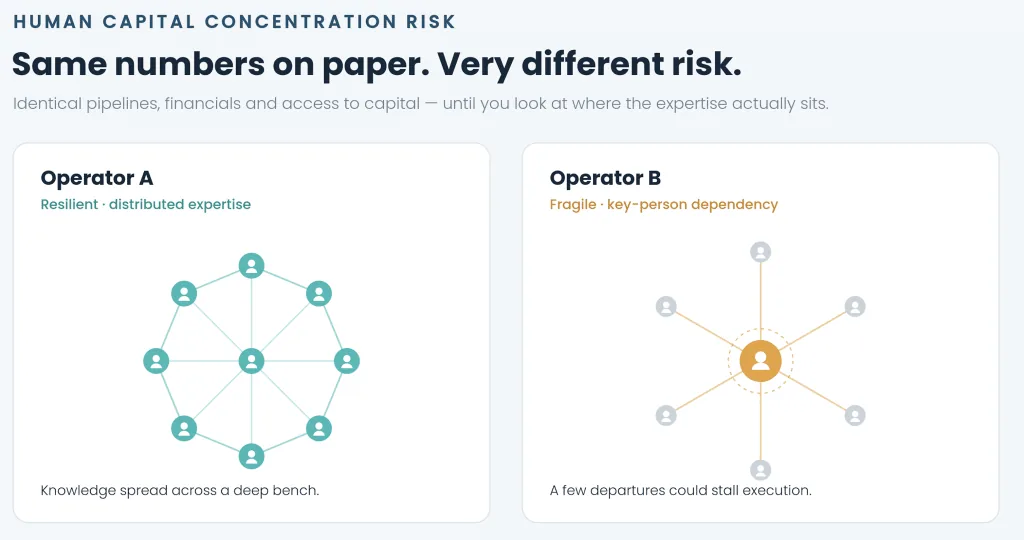
Most investors would agree that these are fundamentally different risk profiles.
The problem is that very few organisations possess a structured way of measuring the difference in workforce capability.
Financial markets have long understood concepts such as customer concentration risk, supplier concentration risk, and refinancing risk. Human capital concentration risk, despite potentially carrying equally significant consequences, remains largely invisible.
As AI-driven infrastructure expansion accelerates, this blind spot becomes increasingly difficult to ignore.
The challenge is not simply finding enough workers. The challenge is understanding capability itself.
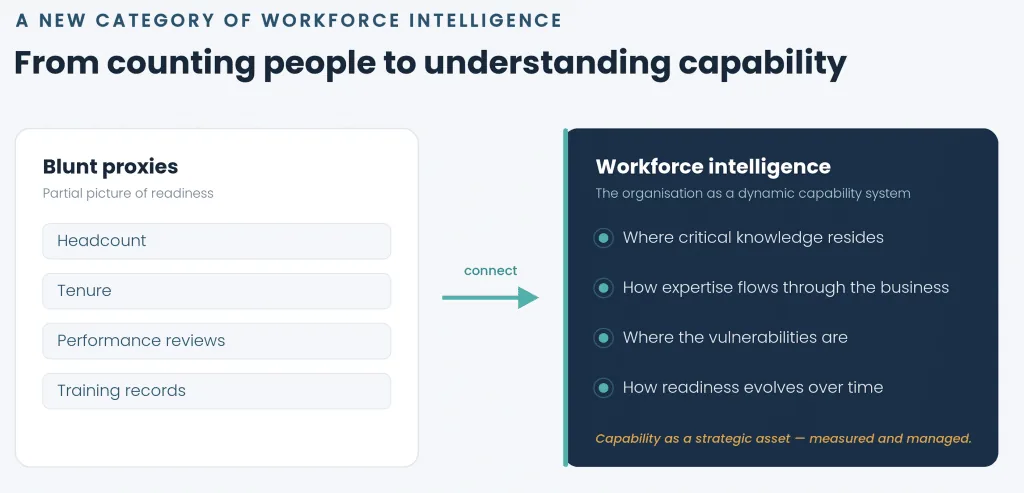
For decades, organisations have relied on relatively blunt indicators such as headcount, tenure, performance reviews, and training records as proxies for workforce readiness. While useful, these metrics often provide only a partial picture of how knowledge, expertise, and leadership capability are distributed across an organisation.
Increasingly, a new category of workforce intelligence is emerging to address this gap.
Rather than viewing employees purely through the lens of human resources, workforce intelligence seeks to understand organisations as dynamic capability systems. It focuses on identifying where critical knowledge resides, how expertise flows throughout a business, where vulnerabilities exist and how organisational readiness evolves over time.
This shift reflects a broader recognition that human capability should be treated as a strategic asset rather than an administrative function.
In much the same way that asset management platforms transformed how infrastructure owners understand physical assets, companies such as Innovorg are exploring how data, analytics and organisational intelligence can help leaders better understand the capability assets that underpin business performance.
The objective is not to reduce people to metrics. If anything, it is the opposite. It is to recognise that the knowledge, judgement, experience and leadership embedded within a workforce are often among the most valuable assets an organisation possesses, even if traditional accounting frameworks struggle to capture that value.
For investors, operators and boards, this raises a question that will become increasingly important throughout the coming decade.
If financial capital can be measured, managed and optimised, and if physical infrastructure can be monitored in real time across global portfolios, should organisations continue to treat workforce capability as something that is largely inferred rather than understood?
The answer may determine which companies are best positioned to navigate the next phase of digital infrastructure growth.
Because while power, capital and land will continue to shape the industry's future, the organisations that create lasting advantage are likely to be those that understand something many businesses still overlook: that behind every megawatt, every facility and every balance sheet sits another asset entirely.
One that rarely appears in annual reports, receives little attention during due diligence processes and cannot be found on any traditional financial statement.
Yet without it, none of the rest works.
It may be time for the industry to acknowledge that it has been operating with two balance sheets all along.