
Capacity is accelerating faster than workforce capability - and most operators don’t see it yet
Everyone is focused on the same constraints in data centre growth: power, land, and capital. And for good reason. Across key markets, operators are navigating grid limitations, planning delays, and increasing competition for sites. These are the constraints that get discussed in boardrooms and investment committees.
But as projects accelerate and AI reshapes demand, another limitation is starting to surface - one that rarely makes it into those conversations. It does not appear in feasibility studies. It is not priced into underwriting models. It is not an infrastructure constraint. It is a workforce constraint. And in many cases, it is already influencing delivery timelines more than most operators are willing to admit.
As digital infrastructure continues to scale, the complexity of operating it is increasing just as quickly. Data centres are becoming more advanced, cloud environments more distributed, and operational expectations more demanding. According to the World Economic Forum, the sector is expected to exceed $135 billion in value by the end of 2026, reflecting its central role in supporting the next generation of digital services.
Yet while infrastructure has evolved rapidly, the systems used to understand and develop workforce capability have not kept pace.
Across the industry, capacity is expanding faster than the workforce required to build and operate it. Demand for high-density environments continues to rise, with some estimates suggesting annual growth rates exceeding 30% in key markets. However, workforce development pipelines remain constrained, particularly in specialised areas such as electrical engineering, advanced cooling, and AI-driven operations.
This creates a structural imbalance. Infrastructure is scaling, but capability is not scaling at the same rate.
The impact is no longer theoretical as industry surveys and recruitment data consistently show that a significant majority of operators are struggling to hire qualified talent, while retention is becoming an equally pressing challenge. In parallel, a large portion of the existing workforce is approaching retirement age, introducing an additional layer of long-term risk.
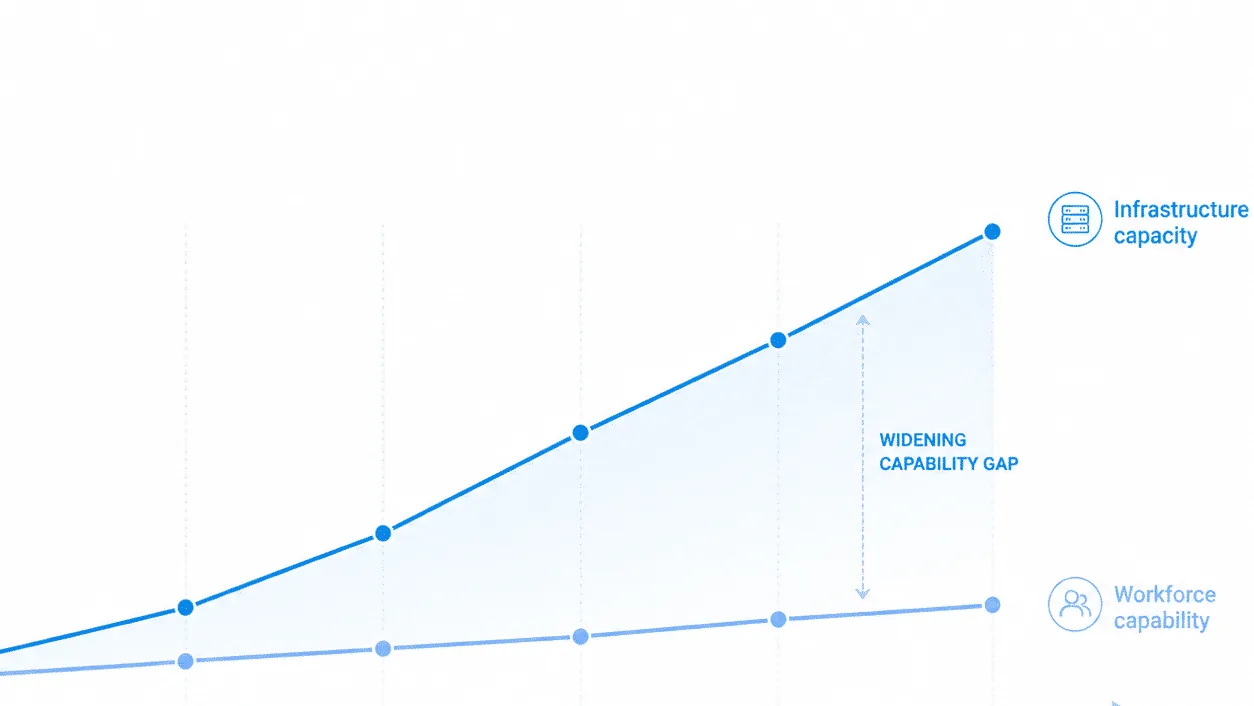
Taken together, these dynamics point to a widening gap between what the industry requires and what the workforce can currently deliver.
The visibility problem behind the talent shortage
However, the more critical issue is not simply a shortage of talent. It is a lack of clarity about workforce capability. In many organisations, skills are tracked across multiple disconnected systems. Training programmes exist in isolation, certifications are managed separately, and workforce planning often relies on incomplete or outdated information. What appears to be a workforce of sufficient scale may, in reality, lack the specific capabilities required to deliver increasingly complex environments.
This creates a blind spot at the leadership level. Decisions about hiring, training, and deployment are made without a clear, unified view of capability. As a result, risks emerge not necessarily because talent is absent, but because capability is not fully understood and the consequences are already becoming visible.
Workforce-related constraints are contributing to delays in construction and deployment, with industry reports indicating that staffing shortages have disrupted operations across a significant proportion of projects. Delivery timelines are becoming less predictable, while operational pressure is increasing as teams are stretched across multiple initiatives.
At the same time, the human impact of this imbalance is intensifying. Even where organisations succeed in hiring, retention remains fragile. High-pressure environments, combined with unclear development pathways, are contributing to burnout and attrition. A growing share of professionals in the sector are actively considering leaving their roles, despite strong demand and competitive compensation.
This introduces a second layer of risk - not just the inability to build capability, but the inability to retain it.
From workforce management to workforce intelligence
Historically, organisations have responded to workforce challenges in familiar ways. They hire more people, invest in training programmes, or rely on external support. While these approaches remain necessary, they are no longer sufficient on their own.
The scale and complexity of modern infrastructure require a more integrated understanding of workforce capability.
What is beginning to emerge is a shift towards workforce intelligence. Rather than treating skills, training, certifications, and workforce planning as separate functions, organisations are starting to connect them into a single, structured system. This provides a more complete and real-time view of capability across teams, roles, and regions.
The implications are significant as with greater visibility, organisations can identify gaps before they impact delivery, align development with actual operational needs, and plan workforce evolution with greater precision. The focus moves away from reacting to workforce issues and towards anticipating them.
This is not a dramatic transformation, but it is a meaningful one. It represents a move from managing training activity to understanding capability as a strategic asset.
The data centre industry has spent the last decade solving for infrastructure constraints such as power, cooling, and connectivity. The next phase will require a different level of discipline - one that applies the same rigour to workforce capability as it does to infrastructure design.
Platforms such as Innovorg are emerging in response to this shift, but not as generic learning or skills tools. Innovorg has been purpose-built for Cloud, Hosting, and Data Centre environments, where the challenge is not simply delivering training, but aligning capability with operational reality. By connecting roles, skills, certifications, learning pathways, and objectives into a single, integrated system, it creates a layer of workforce intelligence that reflects how teams actually operate.
In practice, this allows organisations to move beyond fragmented data and assumptions, and towards a position where capability can be measured, understood, and actively managed.
Leaders gain visibility into where gaps exist, how teams are evolving, and what is required to support growth. The result is not just more efficient training, but more predictable execution - a critical advantage in an environment where delays and misalignment carry significant cost.
Essentially, the industry is approaching an inflection point. Growth will continue. Infrastructure will scale. Investment will follow demand. But the organisations that succeed will not simply be those that build faster. They will be those that understand their workforce more clearly, and who are able to align capability with ambition in a more deliberate and informed way.
Because ultimately, infrastructure does not operate itself. And as the pace of change accelerates, the gap between capacity and capability is no longer a secondary issue. It is becoming the defining one.