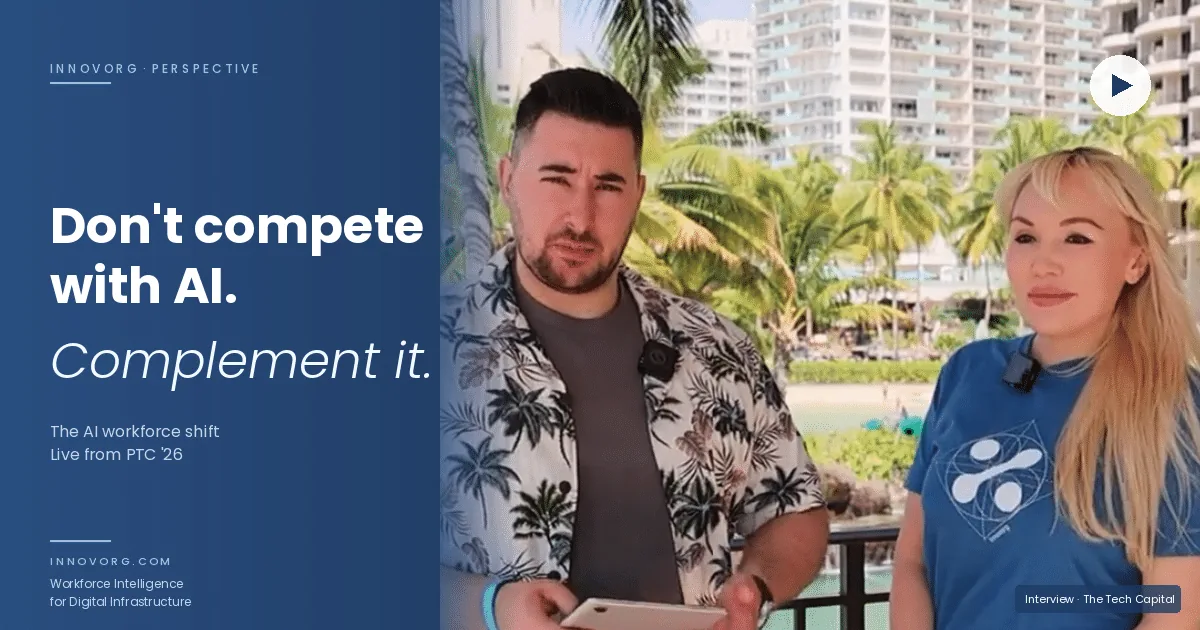
In this interview with The Tech Capital, Innovorg CEO Elya McCleave sets out a clear message: the AI workforce shift is not about job loss, but about whether organisations can adapt fast enough to keep up.
There is a certain rhythm to industry gatherings like PTC. The conversations tend to orbit familiar themes - infrastructure, capital, growth, the next wave of demand. This year, in Honolulu, those themes were still very much present. AI dominated the agenda, as expected. So did the scale of investment required to support it.
But somewhere between the keynote sessions and the corridor conversations, a different question began to take shape. Less visible, perhaps, but no less important. Who, exactly, is going to make all of this work?
“The message is not to compete with AI,” said Elya McCleave, founder and CEO of Innovorg, when she sat down with The Tech Capital to speak during the conference. “The opportunity is to build the skills that complement it.”
It is the kind of statement that sounds obvious at first, almost reassuring. Yet it carries with it a more uncomfortable implication. If the opportunity is there, then so too is the risk - not of being replaced by AI, but of being left behind by it.
For all the headlines about automation and job displacement, McCleave’s perspective is more grounded. The transformation underway is not about eliminating roles, but reshaping them. Entire categories of work are being redefined, not removed.
“We’re seeing the trend, but organisations are not making AI part of their operational design,” she said. And that, more than anything else, may explain why the gap between rhetoric and reality remains so wide.
Rhetoric, reality, and the limits of adoption
The prevailing narrative around AI has been remarkably consistent and include the idea that investment in skills will unlock productivity, automation will free up time for higher-value work, and new roles will emerge as others evolve.
Much of this is supported by research. McKinsey and others have pointed to significant gains tied to workforce development and AI integration. The logic is sound. In practice, however, the transition is proving far less straightforward.
“What we’re seeing is that companies assume AI will stick organically,” McCleave said.
There is a tendency to treat AI adoption as a milestone rather than a process. A training session is delivered. A tool is introduced. A pilot project is launched. And then, quietly, attention shifts elsewhere.
The expectation is that the organisation will absorb the change on its own. It rarely does.
The problem is not a lack of intent. Nor is it a lack of investment. It is a mismatch between the speed of technological change and the way organisations are structured to respond to it.
AI is not a feature that can simply be added to an existing system. It requires a rethinking of how work is done - how decisions are made, how information flows, how teams operate.
That kind of change does not happen through isolated initiatives. It requires integration at a much deeper level.
“It needs to be part of the system, part of the workflows,” McCleave said. Without that, AI remains something external. A tool that exists alongside the organisation, rather than within it.
Where AI actually lives: the frontline
If the boardroom is where strategies are defined, the frontline is where they are tested.
“AI does not make the decisions in the boardroom,” McCleave said. “It’s the frontline where it’s being used.” This is where adoption becomes real. Where theory meets practice. Where the gap between potential and execution is most visible.
Frontline workers are increasingly interacting with AI systems in their day-to-day roles - using co-pilots, automating repetitive tasks, extracting insights from data that would previously have been inaccessible.
In many cases, the benefits are immediate. Tasks that once took hours can be completed in minutes. Information can be processed at a scale that was previously unthinkable. But this shift also introduces new complexities.
The tools themselves are evolving rapidly. Expectations are rising. Roles are becoming less clearly defined, as the boundaries between functions begin to blur. And yet, the support structures around these workers have not kept pace.
“The risk is not with the frontline,” McCleave said. “The risk is with organisations that are not helping them operationalise AI.” It is a subtle but important distinction.
The assumption that workers will resist or struggle with AI adoption is, in many cases, misplaced. The greater risk lies in the absence of a clear framework for how these tools should be used.
A single training session is not enough. Nor is access to the latest technology. What is required is a level of clarity and consistency that allows workers to integrate AI into their daily routines without friction.
That means defining not just what tools are available, but how they should be applied. What “good” looks like. Where responsibility sits. How outcomes are measured.
In other words, it requires operationalisation.
The skills that will define the next phase
For individuals, the implications of this shift are already becoming apparent. The instinctive response to AI is often to focus on technical skills - learning new tools, understanding new systems, staying up to date with the latest developments.
These are important. But they are only part of the picture. “The skills that differentiate you from AI are the ones that humans are good at,” McCleave said.
Communication. Creativity. Context. These are not new ideas. But their importance is increasing as AI systems take on a greater share of analytical and repetitive tasks.
In practical terms, this changes how value is created within organisations. It is no longer enough to execute tasks efficiently. Increasingly, the ability to interpret, to connect, to ask the right questions becomes critical.
The role of the worker shifts accordingly, from operator to orchestrator. This is particularly evident in environments where AI is used to generate insights at scale. The challenge is no longer access to information, but the ability to make sense of it.
“What matters is the ability to frame the right questions and translate insights into action,” McCleave said.
It is a higher-order skill, one that requires both technical understanding and human judgement. And it is one that cannot be developed overnight.
The constraint no one planned for
If there is a single factor that threatens to slow this transition, it is not technological. “It’s not the budgets. It’s not the technology,” McCleave said. “It’s time.”
Time to learn. Time to adapt. Time to integrate new ways of working into already demanding roles. This is where the tension becomes most apparent.
On one hand, organisations are investing heavily in AI, driven by competitive pressure and the promise of productivity gains. On the other, their workforces are already operating at or near capacity.
The expectation is that employees will absorb new tools, develop new skills, and maintain existing performance levels, often simultaneously.
“Skills catalogues are growing, expectations are growing, but are companies allocating the time and resources for staff to keep up? In most cases, they are not,” McCleave said. The result is a form of silent friction.
AI is introduced, but not fully adopted. Tools are available, but underutilised. Potential gains remain unrealised.
Not because the technology is lacking, but because the conditions required for effective use are not in place.
From workforce development to workforce intelligence
Addressing this gap requires more than incremental change. It requires a shift in how organisations think about their workforce altogether. Historically, skills development has been treated as a support function - something adjacent to operations, rather than integral to it.
In an AI-driven environment, that separation becomes increasingly untenable. Workforce capability is no longer a background consideration. It is directly tied to performance.
“Our focus is to make workforce development as rigorous as digital infrastructure operations,” McCleave said. This is the idea underpinning Innovorg’s approach.
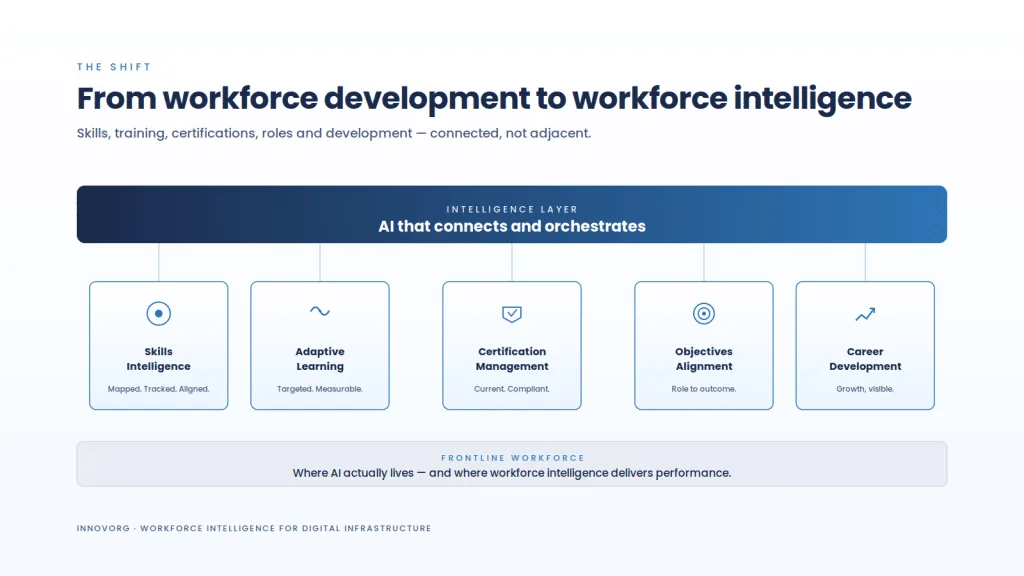
Rather than viewing skills as static attributes, the company positions them as dynamic elements within a broader system. Skills are mapped, tracked, and aligned with specific roles and objectives. Training is not generic, but targeted. Progress is measurable.
The aim is to create a level of visibility that allows organisations to understand not just what their workforce looks like today, but how it needs to evolve. In practical terms, this means connecting multiple layers - skills, certifications, training pathways, job roles, performance metrics - into a single framework. It is, in effect, an intelligence layer for the workforce.
And in a sector as complex as digital infrastructure, where the pace of change is accelerating, that layer becomes increasingly valuable.
What happens next
Looking ahead to 2030, the trajectory of AI is unlikely to slow. If anything, the pace of development will increase. New tools will emerge. Existing systems will become more capable. The boundary between human and machine-led tasks will continue to shift.
But the defining factor in how this plays out will not be the technology itself. It will be the ability of organisations to adapt.
Can they move beyond treating AI as an initiative, and instead embed it into the fabric of how they operate? Can they create the conditions for their workforce to evolve alongside the technology? Can they allocate the time, the resources, and the attention required to make that transition sustainable?
These are not easy questions. And they do not have immediate answers.
What is clear, however, is that the next phase of the AI transition will be shaped less by breakthroughs in technology, and more by the decisions organisations make about their people.
The infrastructure is being built. The capital is being deployed. The tools are becoming more powerful by the day.
The remaining question is whether the workforce is being given the means to keep up. Or, as McCleave puts it, whether organisations are ready to treat workforce readiness not as an afterthought, but as a system in its own right.