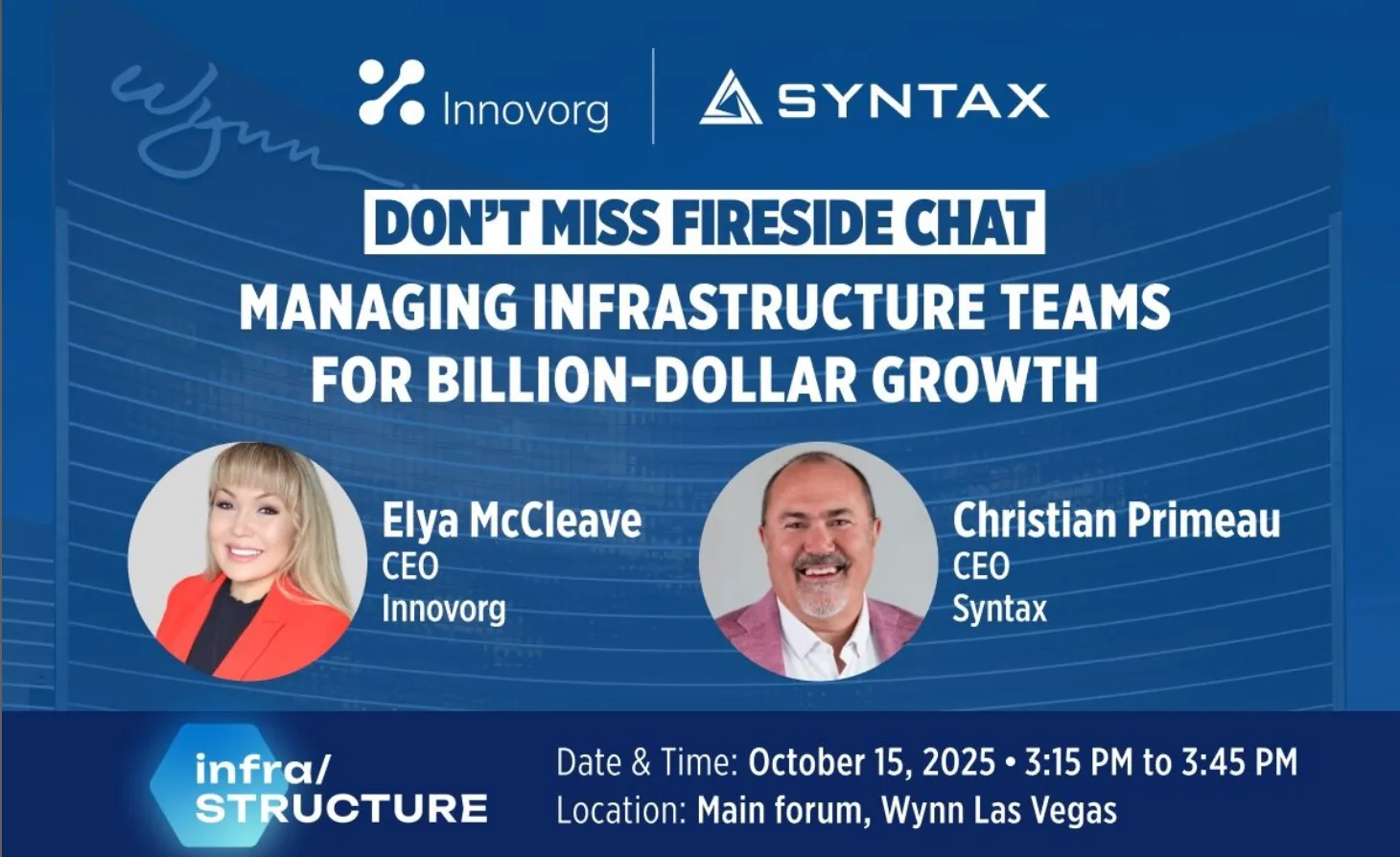
At infra/STRUCTURE Summit, Innovorg CEO Elya McCleave sat down with Christian Primeau, Global CEO of Syntax on "How to Build Infrastructure Teams for Billion-Dollar Growth", for a candid fireside chat on what it really takes to build, scale, and sustain high-performance infrastructure organizations.
With more than two decades of experience leading companies through massive industry transitions — from early internet infrastructure to modern, AI-enabled managed services — Christian shared hard-earned lessons on leadership, talent, culture, and scale.
Below are three of the most important takeaways from the conversation — and why they matter for today’s digital infrastructure leaders.
1. Performance Is Collective — Not Individual
One of the strongest themes in the discussion was Christian’s belief that performance is a team sport.
From his early days at Sun Microsystems through his leadership at iWeb, Internap, and now Syntax, Christian emphasized that growth is not driven by heroic individuals — it’s driven by aligned, empowered teams operating with a clear vision.
High-performance organizations are built by hiring exceptional talent, setting a crystal-clear strategy, and trusting leaders to make decisions as close to the customer as possible.
This mindset shaped major transformations — including iWeb’s successful evolution from a technically excellent hosting company into a customer-centric managed services business, ultimately leading to its acquisition by Internap.
Why this matters now: As infrastructure organizations grow more complex — spanning hybrid, multi-cloud, and AI-driven environments — leadership must move away from centralized control and toward distributed decision-making backed by trust, clarity, and accountability.
2. Curiosity + Execution Are the Ultimate Leadership Skills
When asked how he selects and develops executive talent, Christian was clear: curiosity is non-negotiable — especially in an era defined by AI and rapid change.
But curiosity alone isn’t enough.
The leaders who succeed are those who combine curiosity with strong execution, decisiveness, and follow-through.
The leaders I look for are deeply curious about what’s changing — but they also get things done. And once the direction is clear, I trust them to execute.
At Syntax, this philosophy underpins everything from leadership development to how strategy is communicated. The company publishes an annual strategy whitepaper to ensure that every employee understands where the organization is going and how their decisions connect to that direction.
Why this matters now: In fast-moving infrastructure environments, slow or indecisive leadership silently destroys performance. Christian’s “one bad habit leaders tolerate” was blunt: lack of decision-making.
3. Skills Intelligence Is the Most Powerful (and Underused) Retention Tool
One of the most resonant moments of the fireside chat was Christian’s perspective on skills management — an area where Innovorg and Syntax strongly align.
Christian described skills intelligence as foundational to:
- Hiring and M&A due diligence
- Workforce planning
- Career development
- Long-term retention
You need to understand skills at the individual level — not just what the job requires today, but where the job is going tomorrow. Skills management is the ultimate retention tool.
As jobs evolve faster than ever, leaders must continuously identify skill gaps, align learning to real business needs, and support employee career ambition. According to Christian, this creates value for the company and long-term equity for employees in their careers.
Why this matters now: In people-intensive industries like managed services and digital infrastructure, retention is a skills problem before it’s a compensation problem.
A Real-World Example: Scaling Culture at Speed
Perhaps most impressive is how these principles translate into execution at Syntax.
Since 2018, Syntax has grown from roughly 100 employees to nearly 3,000 — through a mix of organic growth and highly disciplined M&A. Christian described their approach as “boutique at scale” — protecting culture, identity, and value creation even as the company expands globally.
That same philosophy now extends to AI enablement. Syntax has trained its entire workforce on AI fundamentals and created a bottom-up innovation model that has already produced hundreds of employee-built AI agents — with strong governance and guardrails in place.
Final Thoughts
This fireside chat is a powerful reminder that billion-dollar growth doesn’t start with technology — it starts with people, clarity, and skills.
For infrastructure leaders navigating AI disruption, talent shortages, and rising complexity, Christian Primeau’s insights offer a practical blueprint for sustainable scale.
Watch the full Fireside Chat with Christian Primeau: