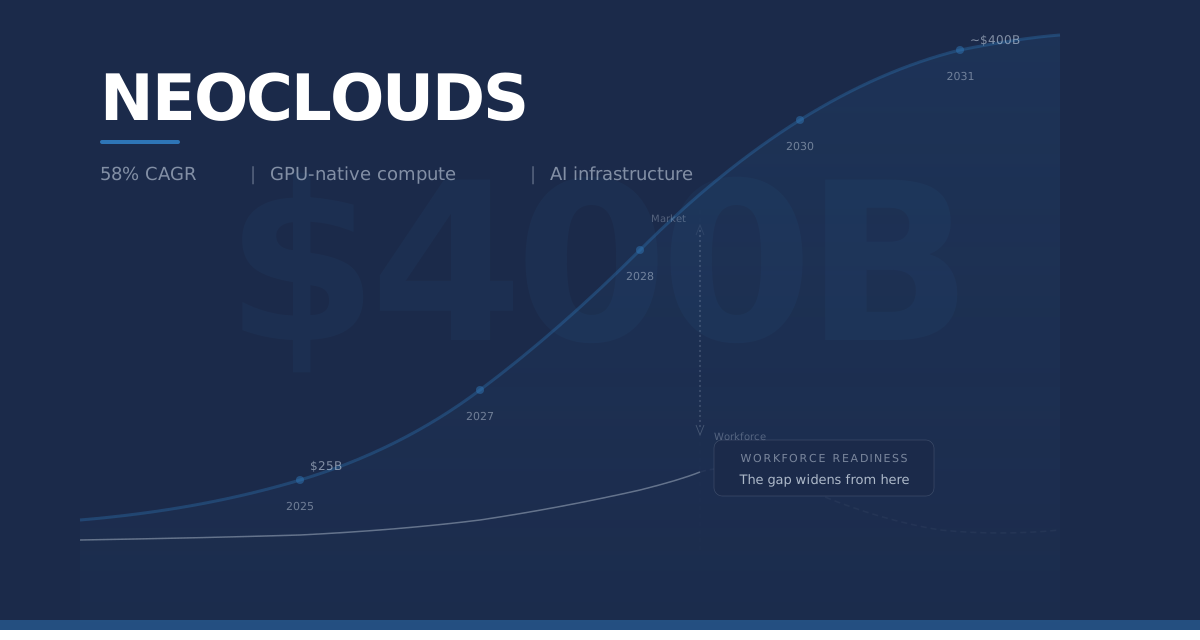
A new layer of cloud infrastructure is emerging at speed, driven by the rapid expansion of artificial intelligence workloads and the structural limits of traditional hyperscale platforms. Neocloud providers, built specifically around GPU-intensive computing, have moved from niche operators to a critical part of the AI supply chain in a relatively short period of time.
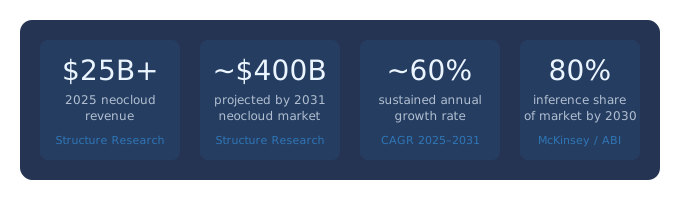
According to the latest data from Structure Research, the neocloud market generated more than US$25 billion in revenue in 2025 and is forecast to approach US$400 billion by 2031, implying sustained annual growth of close to 60%. This aligns with broader industry estimates, with Synergy Research indicating neocloud revenues are growing at rates exceeding 200% annually and could reach close to US$180 billion by the end of the decade.
Based on analysis from McKinsey and ABI Research, this growth is being driven not only by training workloads but increasingly by inference, which is expected to account for up to 80% of the neocloud market by 2030 as AI moves into production environments across enterprise use cases.
Neocloud platforms have gained traction by focusing on performance, flexibility and speed of deployment, often delivering GPU capacity more efficiently than traditional cloud providers. Rather than competing directly with hyperscalers on breadth of services, they have positioned themselves around a narrower, more specialised offering designed to meet the needs of AI-native companies and increasingly, large enterprises. In many cases, these providers have leveraged existing high-density infrastructure, cheap power contracts and deep operational expertise to scale rapidly and challenge established cloud economics.
At the same time, the impact of this shift is becoming visible beyond infrastructure buildout. According to recent network data published by Backblaze, AI-driven traffic between storage layers and neocloud compute environments has increased significantly, reflecting the intensity and concentration of AI workloads compared to traditional cloud usage patterns.
This is not simply a story of more compute being deployed. It is a fundamental reconfiguration of how data moves, how infrastructure is provisioned, and how cloud environments are architected around AI workloads. As neocloud providers continue to scale, they are not just adding capacity - they are reshaping the operational fabric of the cloud itself.
From compute constraint to capability constraint
As the neocloud market expands, the industry narrative remains heavily focused on access to GPUs, power availability and data centre buildout. These remain critical factors, but they are no longer the only constraints shaping growth.
A more structural issue is emerging beneath the surface. As infrastructure becomes more sophisticated, the workforce required to design, deploy and operate these environments is struggling to keep pace. Neocloud platforms depend on highly specialised technical roles, spanning infrastructure engineering, AI workload optimisation, and increasingly complex operational workflows that do not map cleanly to traditional IT structures.
The complexity is not theoretical. Industry initiatives such as the Open Compute Project’s work on scaling AI clusters highlight the practical challenges operators face, from sourcing power and cooling at scale, to integrating heterogeneous hardware environments and managing rapidly evolving system architectures.
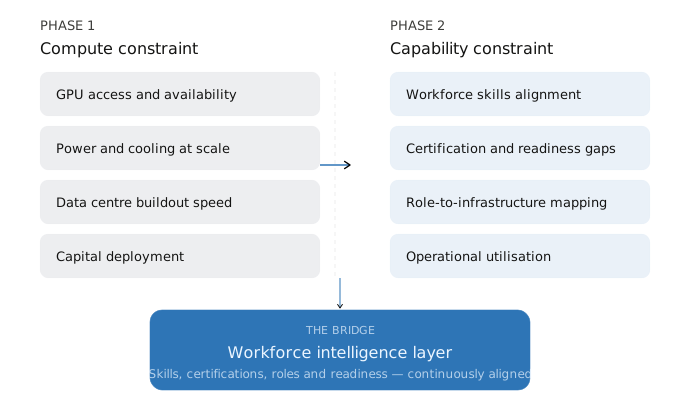
The consequence is a growing gap between capacity and utilisation. Organisations may secure access to compute, but lack the internal alignment, visibility and skills to deploy it efficiently. This results in slower rollouts, underused infrastructure and rising operational costs, even as overall capacity continues to expand.
This is where the concept of workforce intelligence becomes increasingly relevant. In an environment where technology is evolving faster than traditional organisational structures, the ability to connect roles, skills, training and performance into a single operational framework becomes a competitive advantage rather than an administrative function.
For companies operating in or alongside the neocloud ecosystem, this is no longer theoretical. It is a practical requirement. Understanding where skills exist, how they map to evolving infrastructure demands, and how teams can be redeployed or upskilled in real time is becoming central to execution. The shift underway is subtle but significant - from a focus on acquiring infrastructure, to a focus on activating it.
This is precisely the gap platforms such as Innovorg are designed to address. By creating an intelligence layer that connects workforce capability to operational demand, organisations are able to move beyond static workforce planning and towards a model where skills, certifications, training and roles are continuously aligned with the requirements of AI infrastructure. In practice, this allows neocloud operators and enterprise users to deploy faster, reduce inefficiencies and extract more value from the same underlying compute.
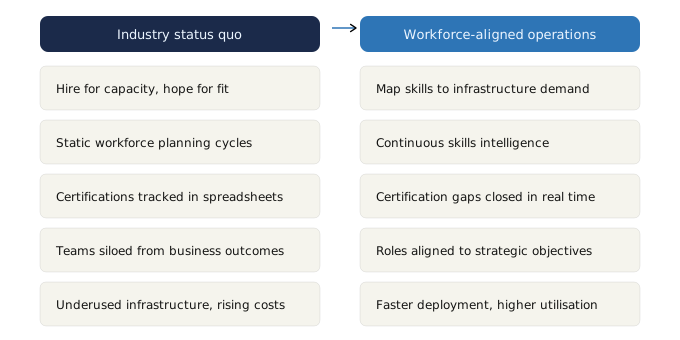
In a market projected to reach hundreds of billions of dollars, the implications are significant. The first phase of the neocloud buildout has been defined by capital deployment and infrastructure expansion. The next phase will be defined by how effectively that infrastructure is utilised.
The companies that succeed will not necessarily be those with the largest clusters or the lowest cost of compute, but those that can align their workforce with the demands of AI infrastructure in a precise and scalable way. As the industry matures, the defining question is shifting - not how to build capacity, but how to use it.
SOURCES & FURTHER READING
• Synergy Research Group — Neocloud Market Forecast to Approach $400B by 2031
• McKinsey & Company — The Next Big Shifts in AI Workloads and Hyperscaler Strategies (2025)
• McKinsey & Company — AI Power: Expanding Data Center Capacity to Meet Growing Demand (2024)
• ABI Research — The State of Neocloud: Four Trends for 2026
• Backblaze — Q4 2025 Network Stats: Neocloud Traffic Trends
• The Tech Capital — AI Boom Drives Neocloud Market Towards $400 Billion by 2031