
Reflections from SIJORI Week 2025 across Singapore and Indonesia
SIJORI WEEK — the Singapore–Johor–Riau Islands growth triangle — has quickly evolved from a regional talking point to a real, multi-gigawatt digital infrastructure corridor. Organized by W.Media, SIJORI Week 2025 brought operators, cloud providers, policymakers, and talent leaders together for tours, forums, and the marquee SIJORI Cloud & Datacenter Convention in Singapore. The week spanned early July with activities across Singapore, Johor, and Batam; the convention itself took place on July 10 at Marina Bay Sands.
Three markets, one ecosystem
Singapore remains the anchor for connectivity and latency-sensitive workloads with ~1.4 GW of installed data-center capacity across 70+ facilities, and the government plans to open ~300 MW of additional capacity via high-efficiency, low-carbon designs. This blend of performance and sustainability continues to set the region’s standards.
Johor (Malaysia) is scaling at breakneck speed as Singapore’s close-coupled expansion zone. New campuses — including Yondr’s 300 MW site at Sedenak Tech Park and PDG’s 150+ MW AI-ready JH1 — signal hyperscale-first design thinking and serious capital formation. Broader analyses now call Johor one of the world’s most significant AI buildouts.
Batam (Riau Islands, Indonesia) is emerging as the interconnect and resiliency “pressure valve” for the triangle, with 12 active subsea cables and 3 more under construction, plus growing DC campuses at Nongsa Digital Park. Oracle has reportedly explored a Batam cloud region; NeutraDC and partners are advancing renewable-powered builds targeting near-term operations.
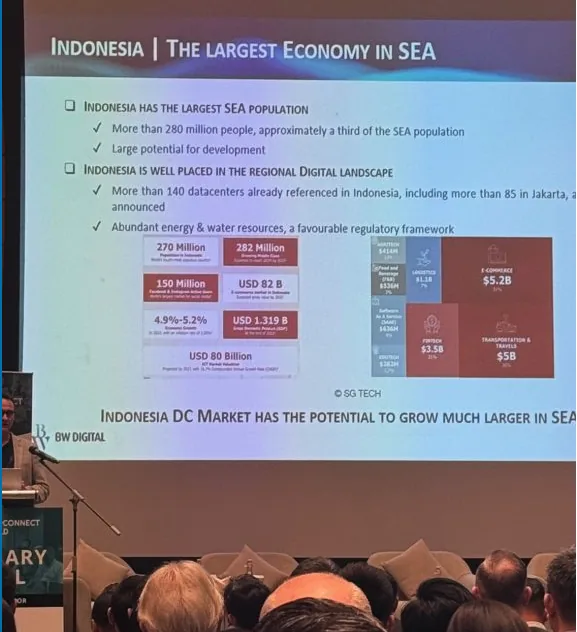
SIJORI Week 2025 highlights
The 2025 edition doubled down on AI-ready infrastructure — from smart cooling and renewable integration to cross-border interconnects and capacity planning. Post-event coverage emphasized the region’s trajectory toward “SIJORI+” — a wider APAC constellation leveraging Singapore’s network gravity, Johor’s land/power scale, and Batam’s cable-rich edge. Attendance topped the thousands across the week’s activities.
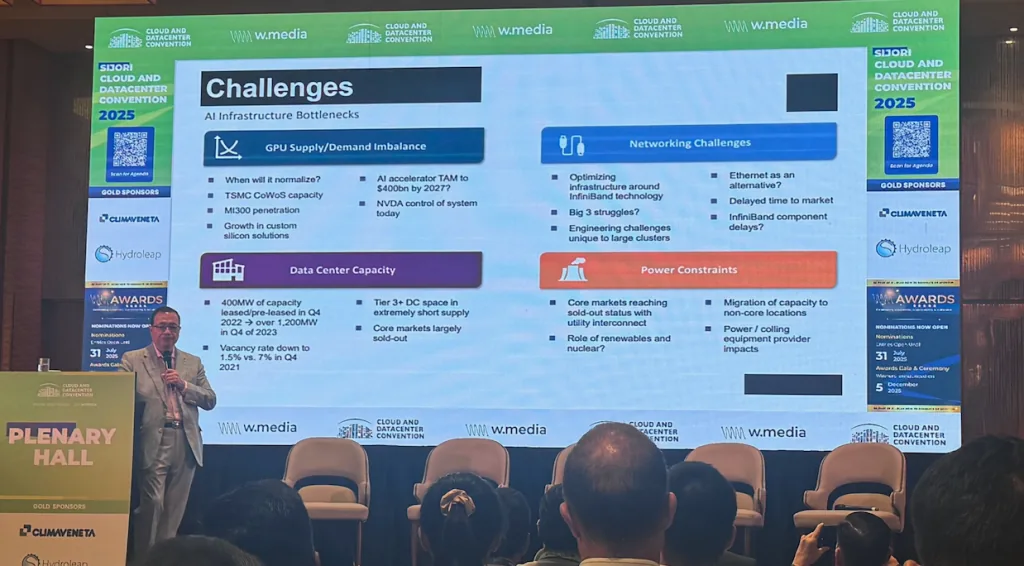
The demand shock is here — so is the talent crunch
Even with APAC supply set to double in ~3 years, analysts still see 15–25 GW of unmet demand by 2028, driven by AI training/ inference, cloud growth, and data-sovereignty needs. That growth is already spilling into secondary markets (Johor, Batam) and putting intense pressure on skilled headcount. (Network World, CBRE)
On people, the story is stark: the Uptime Institute has long flagged a global need on the order of ~2.3 million data-center workers by 2025, and operators continue to report hiring difficulty across critical roles. Governments and hyperscalers are responding — Indonesia is targeting 9 million digital talents by 2030, while Microsoft has paired new regional cloud/AI investments with large-scale skilling pledges across ASEAN.
What does this mean for operators and service providers?
- Design for cross-border operations. Treat Singapore, Johor, and Batam as a single logical footprint: place latency-critical workloads in Singapore, scale AI/ general compute in Johor, and use Batam for interconnect diversity and failover. (W.Media, DataCenterDynamics, neutradc.com)
- Power, permits, people — prioritize all three. Policy signals (e.g., Singapore’s efficiency-linked capacity releases; Malaysia’s evolving energy tariffs) make the workforce the differentiator you can control today. (W.Media, Financial Times)
- Make AI workloads talent-aware. High-density, AI-ready designs raise the bar for electrical, mechanical, and network expertise — plus safety, reliability, and sustainability competencies. (W.Media)
Innovorg’s blueprint for SIJORI-era workforce readiness
From conversations and sessions throughout SIJORI Week, three practices separate the leaders:
- Skills visibility at role depth. Inventory each site/region’s real skills mix (power, cooling, fiber/optical, interconnection, controls, safety, compliance, DCIM) down to proficiency — and map to job scorecards.
- Forecasting, not guessing. Use demand signals (new MW, rack densities, interconnect changes, AI workload profiles) to forecast gaps 3–6 quarters ahead— then align hiring, contracts, and training.
- Adaptive development for HiPo roles. Shorten time-to-proficiency for technicians, MEP engineers, network/interconnect specialists, and site reliability roles with personalized pathways, mentoring, and certifications tied to live scorecards.
This is exactly where Innovorg helps: our platform builds a live skills inventory, runs gap analysis and forecasting, and delivers individualized learning (including HiPo and Career-pathing) to close gaps quickly—so you’re not stuck hiring into a shortage without upskilling your core team.
Closing thought
SIJORI Week made one thing obvious: capacity will come, but capability wins. The operators that treat talent as a strategic system — visible, forecastable, and continuously developed—will scale fastest and safest across the triangle and the broader APAC network.
Book a session with us to check how ready you are to scale → Contact Us