Every year, the same ritual plays out in critical facilities and network operations teams around the world. Managers scramble to reconstruct twelve months of shift work, incident responses, and project deliveries from memory. Engineers fill in self-assessments they know won't change anything. HR chases completion rates. And when it's over, everyone quietly agrees it was a distraction from the actual work of keeping infrastructure running — until next year, when we do it all again.
Here's the uncomfortable truth: the annual performance reviews in Data Centers are not failing because your people are doing it wrong. They are failing because they were designed for a world of work that no longer exists — and nowhere is that more obvious than in digital infrastructure.
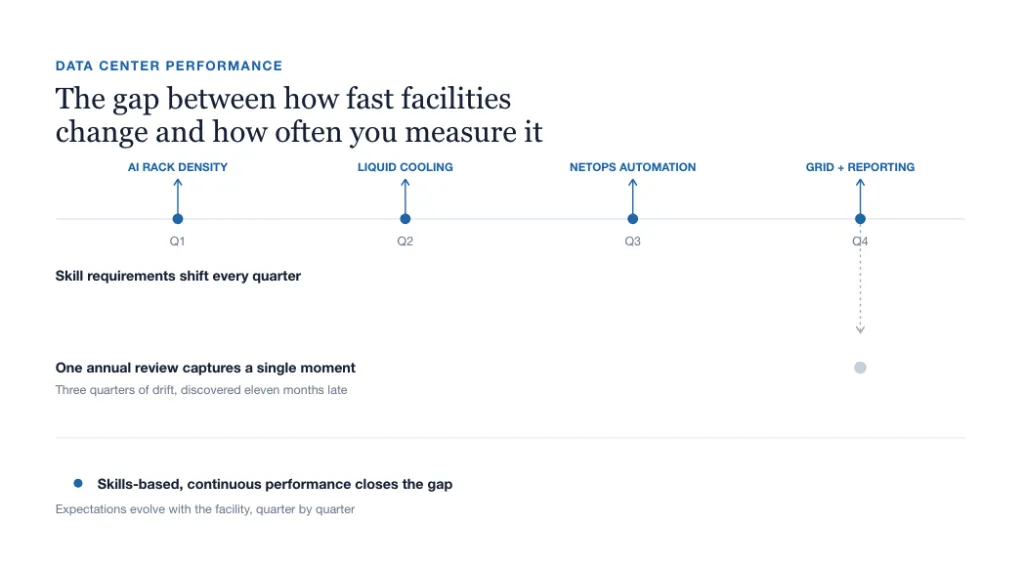
Built for stable roles. Deployed in the fastest-changing sector on earth.
The annual review made sense when roles were static, and skills had a shelf life of a decade.
Now look at a Data Center Builder and Operator in 2026.
AI workloads are rewriting facility design in real time — rack densities that were theoretical three years ago are now standard deployments. Liquid cooling went from niche to mandatory. NetOps teams are absorbing automation, orchestration, and AI-assisted operations into roles that were built around manual runbooks. Sustainability reporting, grid constraints, and heat-reuse requirements are adding entirely new competency areas to jobs that never included them.
Meanwhile, the industry faces a structural talent shortage. Experienced operators are retiring, demand for capacity is exploding, and every operator is competing for the same scarce pool of critical environment engineers.
In that environment, a 12-month feedback cycle isn't just slow. It's structurally incapable of doing its job. The skills that define a competent data center technician, network engineer, or capacity planner are shifting faster than most organizations can update a job description — let alone a review template.
The real problem: we measure last year and call it development
Most performance systems in our sector are rearward-facing by design. They ask: did you meet your uptime targets? Did you close your tickets? Rarely: are you ready for what this facility will need in eighteen months?
That distinction is existential for infrastructure operators, because winning on talent now means answering three questions with confidence:
- What skills does this role actually require today — not when the job req was written? (Does your electrical technician role reflect liquid cooling? Does your NetOps role reflect automation?)
- What skills does each engineer actually have — demonstrated on shift, not assumed from a title or a certification earned years ago?
- What's the fastest path to close the gap — and who owns it, in an industry where you can't simply hire your way out?
An annual review answers none of these. It produces a rating, an awkward conversation between shifts, and a document nobody opens again.
What forward-looking operators are doing differently
Across digital infrastructure, a clear pattern is emerging among organizations that have moved past the annual event:
They separate development from evaluation. When one conversation has to be both coaching session and pay negotiation, you get less of both. The shift manager defends a rating; the engineer defends themselves. Nobody develops — and in a sector where internal development is the only realistic answer to the talent shortage, that's an operational risk, not an HR problem.
They make performance skills-based. Instead of vague competencies and gut-feel ratings, they anchor expectations to observable, role-specific skills — which makes feedback concrete, makes cross-training visible, and connects individual performance directly to workforce planning and capacity growth.
They make expectations collaborative. Role clarity in a critical facility isn't something HR hands down from headquarters. The most effective operators build shared, living definitions of what success looks like on the floor — co-owned by the manager and the engineer, updated as the technology stack changes.
They increase conversation frequency before they buy anything. The highest-leverage change isn't another platform or another dashboard. It's more frequent, better-structured conversations between team leads and their people — including across shift patterns, where development conversations are hardest to sustain and most often skipped.
This is exactly what we built Innovorg for
We didn't arrive at this conclusion recently. Purpose-built for digital infrastructure, it's been our operating thesis for years — and it's baked into the platform architecture.
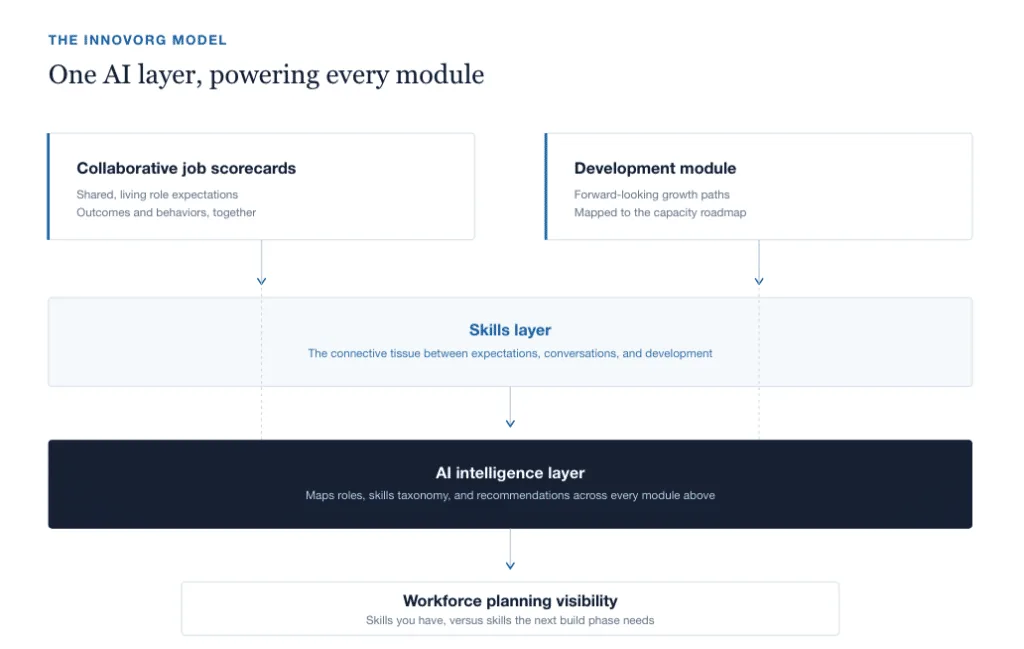
Collaborative Job Scorecards replace static job descriptions and one-directional review templates. Managers and engineers build a shared, skills-based picture of what the role requires and what great performance looks like — both the outcomes (the what: uptime, incident response, project delivery) and the skills and behaviors behind them (the how). Because scorecards are living documents, expectations evolve as the facility evolves — new cooling technology, new automation tooling, new compliance requirements — not once a year.
The Development Module turns every performance conversation into a forward-looking one. Instead of ending a review with a rating and a shrug, team leads and engineers leave with a concrete, skills-based development path — mapped to where the role, the facility, and the capacity roadmap are heading. That's how you grow your next generation of critical environment leaders instead of hoping to hire them.
And everything is skills-based, end-to-end. Skills are the connective tissue between role expectations, performance conversations, development plans, and workforce planning. That's what makes feedback actionable instead of anecdotal — and what lets operations leaders see, in real time, whether the capabilities the next build phase requires are actually being developed in the teams they already have.
The result: performance management stops being a compliance exercise and starts doing what infrastructure operators desperately need it to do — grow scarce talent, close critical skill gaps, and de-risk the capacity roadmap.
Where to start
You don't need to burn down your entire performance process before the next audit. But you do need to ask three honest questions:
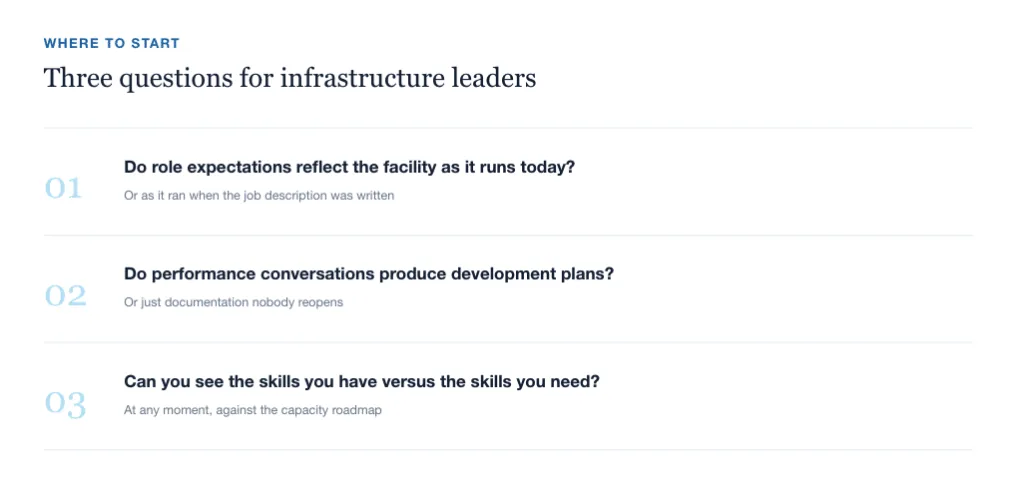
If the answer to any of these is no, the problem isn't your engineers or your team leads. It's the system they've been handed.
The annual review had a good run. But in digital infrastructure, performance is a continuous, skills-based conversation now — and the operators who treat it that way will be the ones who keep their best people while everyone else fights over the same shrinking talent pool.
Curious what skills-based performance looks like in a live operation? See how Innovorg's Job Scorecards and Development Modules help data center and NetOps teams turn performance management into a talent engine. Book a demo