A Head of Operations is responsible for more than 120 engineers across multiple sites, each team responsible for keeping critical infrastructure running smoothly. On paper, everything is in place. Certifications are logged, training programmes exist, and roles are defined. From a distance, it looks organised, even controlled.
And yet, when a new deployment accelerates, or a major upgrade is scheduled, the same uncertainty resurfaces. Who is genuinely ready to take this on? Where are the gaps that haven’t yet surfaced? How long would it take to bring the right people up to speed?
The answers are rarely immediate, and almost never sit in one place. Instead, they are scattered across systems, spreadsheets, internal knowledge, and assumptions. In an industry where timelines are tightening and expectations are rising, that lack of clarity becomes more than an inconvenience. It becomes a risk.
The Scale of Growth — and the Constraint Nobody’s Talking About
The digital infrastructure sector is entering a phase of sustained and accelerated growth with data centre capacity continuing to expand, AI workloads introducing new operational demands, and investment into cloud and infrastructure ecosystems showing little sign of slowing. Traditionally, constraints in this space have been framed in terms of power availability, land, and capital, but increasingly, operators are encountering a different kind of limitation — one that is less visible, but no less critical: workforce capability.

Sources: McKinsey: The Cost of Compute — A $7 Trillion Race to Scale Data Centers (2025) | Uptime Institute Global Data Center Survey 2025 | World Economic Forum Future of Jobs Report 2025
Industry research, including surveys from the Uptime Institute, consistently exposes staffing and skills shortages as one of the top concerns among data centre operators. Their 2025 Global Survey found that two-thirds of operators report difficulty finding or retaining qualified staff — with senior management roles now harder to fill than entry-level positions for the first time. At the same time, the World Economic Forum’s Future of Jobs Report 2025 projects that 59% of the global workforce will need reskilling or upskilling by 2030, with 39% of core skills expected to change.
And yet, in many organisations, the challenge is not simply a lack of talent. It is the inability to clearly see, understand, and act on the capability that already exists within the workforce.
The Fragmentation Problem
Most organisations are not starting from zero as they have invested in learning platforms, certification frameworks, and performance systems. They are tracking activity, monitoring progress, and, in many cases, encouraging continuous development. The problem is that these efforts are often fragmented.
Learning sits in one system. Certifications are tracked in another. Skills may exist in spreadsheets or not be formally mapped at all. Performance data is captured separately, often disconnected from both learning and capability. The result is a landscape where information exists, but insight does not.
Leaders may know who has completed a course, but not whether that translates into operational readiness. They may see certification status, but not how it aligns with real-world requirements. They may understand performance at a high level, but lack a clear picture of the underlying capabilities that drive it.

The Emergence of Workforce Intelligence
This is where a shift is beginning to take shape, and with it, the emergence of a new way of thinking about workforce systems.
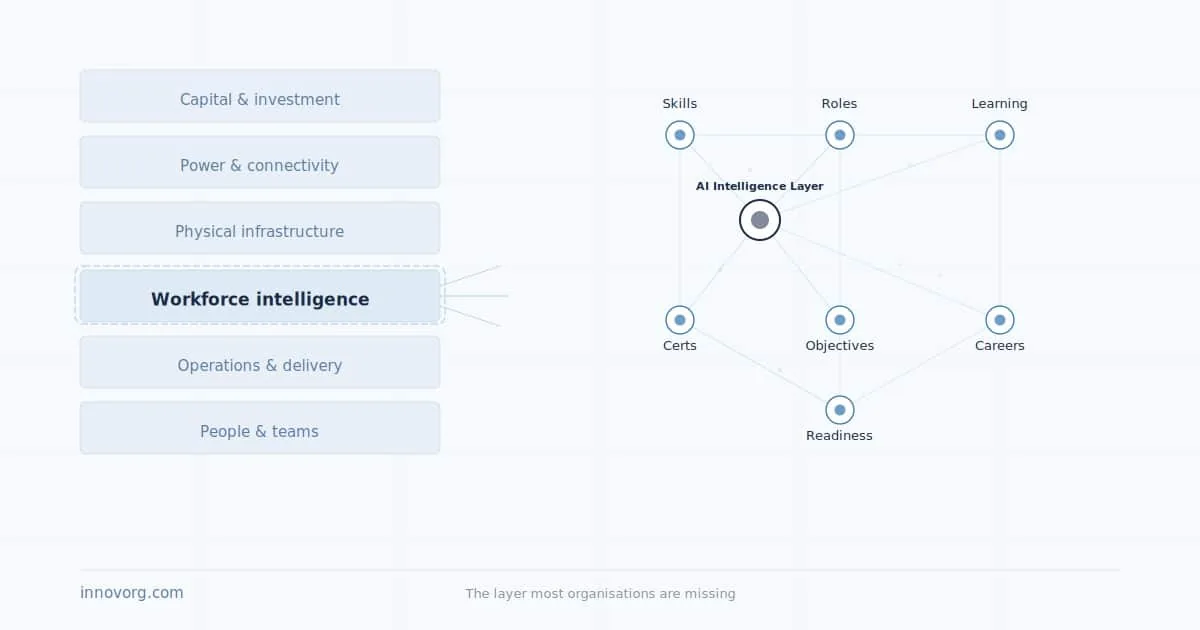
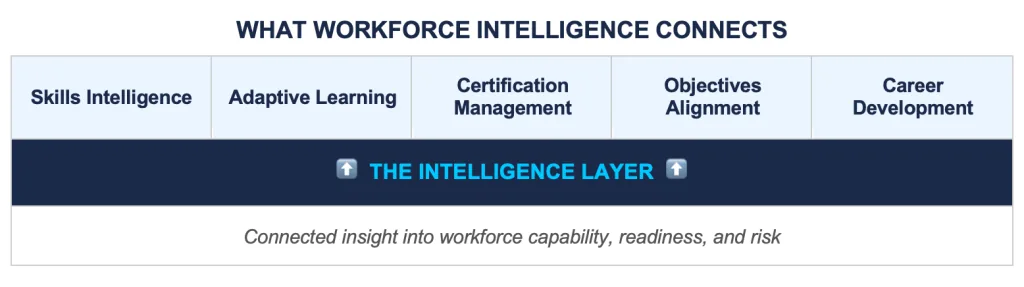
Rather than treating learning, skills, certifications, and roles as separate domains, organisations are starting to connect them into a single, coherent layer — one that allows workforce capability to be understood in context. This is what can be described as workforce intelligence.
Workforce intelligence is not another tool layered on top of existing systems. It is the connective tissue that links them together, turning fragmented data into something that can be interpreted, trusted, and acted upon. It allows organisations to move beyond tracking activity and towards understanding readiness. Instead of asking who has completed what, the question becomes more meaningful: who is ready, and what needs to happen next?
Why This Matters Now
The relevance of this shift becomes clearer when viewed against the realities of modern infrastructure environments. Systems are becoming more complex, deployments are happening faster, and the margin for error is shrinking. At the same time, teams are more distributed, learning is more dynamic, and organisations are increasingly reliant on partners and external ecosystems. In this context, assumptions carry a cost.
The numbers reinforce the urgency. McKinsey projects that data centres will require up to $6.7 trillion in capital expenditure by 2030 to keep pace with demand. That investment will require significant labour — an estimated 12 billion labour hours, equivalent to six million people working full-time for a year. Meanwhile, the Uptime Institute estimates that up to half of all data centre engineers may retire in the next three years, while the global need for engineers is expected to rise by approximately 300,000 over the same period.
If workforce capability cannot be clearly seen, it cannot be effectively managed. If it cannot be managed, it becomes difficult to scale with confidence, reduce operational risk, or align talent with strategic priorities.
From Tracking Activity to Understanding Capability
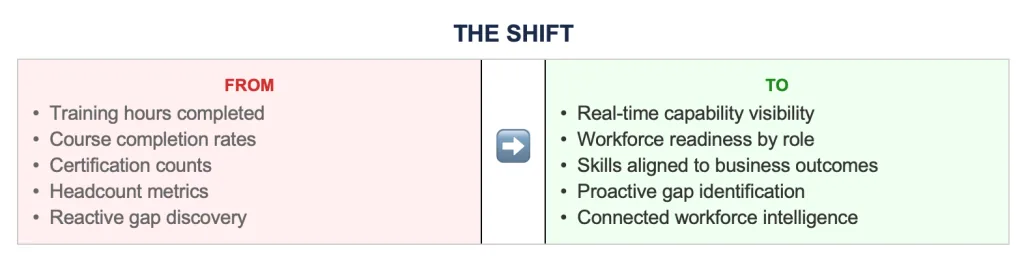
What workforce intelligence enables is not simply better reporting, but a different level of control. It allows organisations to identify gaps before they impact delivery, align development efforts with real business needs, and reduce the administrative burden that often accompanies workforce management. It creates a clearer link between individual growth and organisational performance, making both more predictable.
There is also a broader shift taking place in how organisations think about talent itself. The conversation is moving away from inputs — training hours, course completions, certifications — and towards outcomes. What matters is not what has been done, but what capability exists as a result.
This requires a different kind of system, but also a different mindset. One that recognises that workforce capability is not static, and that visibility into that capability is not a one-time exercise, but an ongoing requirement. In this sense, workforce intelligence is less about adding complexity and more about removing ambiguity.
The Defining Factor
The organisations that will lead in digital infrastructure over the coming years will not be defined solely by how quickly they can build or how much they can invest. Those factors remain important, but they are no longer sufficient on their own.
Leadership will increasingly depend on the ability to understand and develop the workforce with the same level of precision applied to infrastructure itself. To see capability clearly, to evolve it continuously, and to align it directly with strategy. Because, ultimately, infrastructure does not scale on capital alone. It scales on people.

Platforms such as Innovorg exist as a response to this shift, designed specifically for Cloud, Hosting, and Data Center environments, with the aim of connecting workforce data into a single, usable layer of insight — one that links roles, skills, certifications, and development into something organisations can actually understand and act on.
For a Head of Operations in that position, overseeing teams across multiple sites, that changes the nature of the job entirely. The questions do not disappear, but the answers become visible. Readiness is no longer inferred from fragments, but understood as a whole. Decisions become clearer, faster, and more grounded in reality.
And that is ultimately what this shift is about. Not adding another system. Not increasing complexity. But replacing uncertainty with clarity.
Because as infrastructure continues to scale, the organisations that succeed will not just be those that build more, but those that understand their people better.
SOURCES & FURTHER READING
• McKinsey: The Cost of Compute — A $7 Trillion Race to Scale Data Centers (2025)
• McKinsey: The Data Center Dividend
• Uptime Institute Global Data Center Survey 2025
• Uptime Institute Global Data Center Survey 2024
• Uptime Institute Global Data Center Staffing Forecast 2021-2025
• World Economic Forum Future of Jobs Report 2025
• DataX Connect: 5 Reasons for the Skills Shortage in the Data Centre Sector